There is a particular smell to a freshly-pressed shirt in a Spanish abuela's wardrobe that does not exist in most British homes.
It isn't louder or more perfumed than its UK counterpart — if anything, it is gentler, drier, more settled. But it is undeniably there days after the shirt was washed, and it tells you straight away that whoever owns the wardrobe has been doing laundry the same careful way for forty years.
Spanish and Italian grandmothers have a handful of simple laundry habits that most British homes never picked up. They aren't secrets, exactly — just things that were never written down on a packet because they were assumed. Here are five of them, observed across the @dulcearmonia community and the homes we visit when we travel for the brand, gently translated for a British kitchen and a British washing machine.
A note before we start: not every Spanish home does every one of these things, and the patterns are weakening with each generation as Mediterranean homes adopt more British and American conveniences (the tumble dryer, the supermarket pearl booster, the fragrance-free detergent for sensitive skin). What follows is the traditional pattern — the way an older generation tends to do things — not a universal claim about all Spanish or Italian households today.
1. The smell isn't there at the door of the machine. It's there days later.
Ask an older Spanish home cook to describe how the laundry should smell, and she won't reach for the words that mainstream UK detergent ads do. She won't say strong, powerful, bold. She'll talk about the smell settling, resting, coming back — the way bread does after it cools, or the way a stew tastes better the next day.
The cultural difference is real. British laundry products are mostly judged on the door-of-the-machine moment: open the washing machine, breathe in, decide if you like the smell. Spanish and Italian laundry products are mostly judged on the bedding-on-day-seven moment: pull the sheet out of the cupboard, breathe in, decide if the wash from last week is still there.
That single shift in what you're optimising for changes everything else on this list.
2. Smaller bottles, higher concentration, smaller doses
Walk through a Mercadona aisle in Andalusia and you'll see baskets full of 200 ml bottles where a British Tesco shopper would expect five-litre tubs. The Mediterranean approach to home fragrance leans almost entirely on small bottles of concentrated product, not large bottles of dilute product.
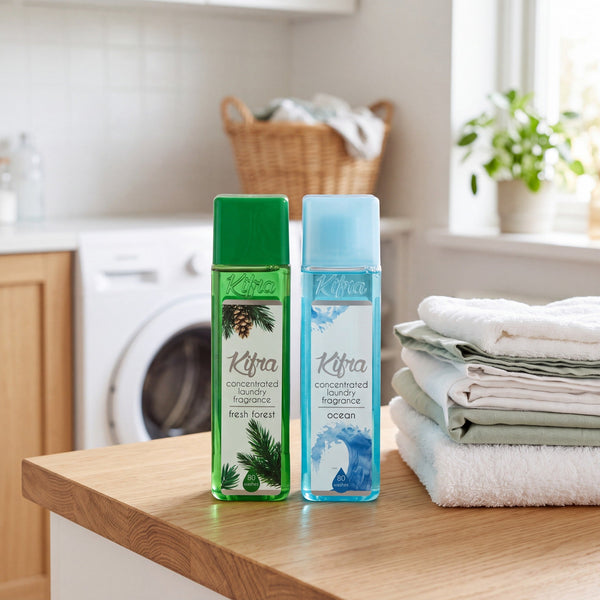
A capful of a Spanish-style softener like Asevi Pink Talco/Rosa on a normal wash gives a result that takes far more of a UK supermarket softener to match. A 2.5 ml dose of Kifra Fresh Forest in the softener drawer does the same job, capful for capful, that a much larger pearl-booster scoop does. Less product, used more thoughtfully, lasts longer in the home and goes further on the shelf.
This is partly economic — utility cupboards in Spanish flats are smaller than British under-sink areas — and partly philosophical. Where Britain treats the wash basket as a quick-finish problem, a Mediterranean grandmother treats it as a slow craft.
3. Almost nothing goes in a tumble dryer
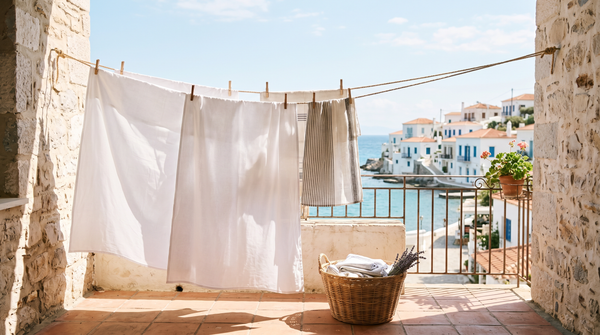
The tumble dryer is the appliance Mediterranean homes accepted last, and the appliance most older Spanish and Italian women still mistrust. Sheets, towels, shirts, tea towels, dish cloths — almost everything in a traditional Spanish utility room ends up on a clothesline strung between balcony walls, on a rooftop, or on a wooden airer indoors.
The reason is partly the climate. A balcony in Valencia dries a bedsheet in three hours; a kitchen radiator in Manchester takes a day. But the reason is also fragrance. Tumble drying breaks the bond between fragrance oil and fibre, so a towel that came out of the wash smelling of Asevi will come out of the dryer smelling of warm towel. An air-dried towel keeps the scent in.
You can do this in Britain too. A heated airer, a clothes line strung in a sunny window, or even a regular airer near a radiator will get most of the same result. It takes longer, but the smell on day seven is the difference.
4. There are sachets at the back of every drawer
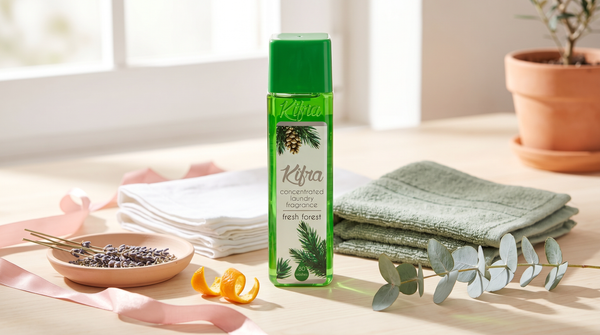
Open a wardrobe in a Spanish grandmother's home and you will find small fabric sachets tucked behind the shirts, behind the bedding, in the corners of jumper drawers. The contents vary by household and by region — dried lavender from a garden, dried rosemary tied with thread, cotton wool soaked in a few drops of a favourite scent, sometimes a knotted muslin of bay leaves and orange peel.
The purpose is the same in every case. The sachets keep the wardrobe smelling continuously, week to week, rather than relying on the scent that came in with the wash to do all the work.
This is the easiest Spanish habit to adopt in a British home. A small cotton-wool ball dabbed with a few drops of your laundry perfume, tucked behind the shirts in the wardrobe, will quietly refresh every garment near it for days at a time. Refresh the cotton wool once a month and the wardrobe never reverts to neutral.
5. Sunday is reset day
The last habit is the one most British homes have lost altogether: a fixed, weekly day for the laundry-and-home-fragrance reset.
In a traditional Spanish home, Sunday morning is when sheets are changed, towels are washed, the airing cupboard is aired out with the door open, and the small jobs around the home's smell are quietly attended to. The new sheets go on the bed. The drawer sachets are refreshed. The radiator-dried towels go back to the shelf. The cotton-wool ball at the back of the wardrobe is replaced.
Each individual task takes only a few minutes. Done together, on the same morning, every week, they build a level of home freshness that no single one-off product can match.
This is the one piece of the Mediterranean approach that doesn't cost a penny. It's the rhythm.
Frequently asked questions
Why do Spanish homes smell different from British homes?
A traditional Spanish home leans on small bottles of concentrated laundry fragrance, weekly air-drying rather than tumble-drying, fabric sachets in drawers, and a fixed weekly laundry rhythm. The result is a continuous, gentle, lived-in level of fragrance that builds wash after wash. British homes more often rely on a single supermarket booster and a tumble-dried wash, which gives a stronger door-of-the-machine moment but fades by the next day.
What is the secret to Spanish-hotel-style bedding?
Most Spanish hotels — and most Spanish grandmothers — wash bedding at 60 °C with a small dose of concentrated laundry perfume in the softener compartment, then air-dry on a line or a rail rather than tumble-drying. The bedding is rotated weekly, with the previous week's set folded into a cupboard alongside a small fabric sachet to keep it fresh between uses. None of this is unusual or hard to copy.
Where can I buy traditional Spanish laundry products in the UK?
Asevi softeners — the everyday pink-and-floral Spanish softener line — are stocked at Dulce Armonía, where the Pink Talco/Rosa, Sensations Passion and Sensations Dreams ranges are available from £3.35 to £3.59 per bottle. Concentrated Italian and Swiss-style laundry perfumes like the Kifra range pair well with them and are also available at Dulce Armonía. For other Spanish brands (Mistol, Sanytol, KH-7), look at Amazon UK or specialist Spanish-product importers.
Adopt one habit this week
Out of the five, the easiest to start with is number four: the wardrobe sachet. Take a single cotton-wool ball, dab on five drops of Kifra Fresh Forest or an Asevi Sensations softener, and tuck it behind the shirts in your wardrobe before bed tonight. By Friday, the whole wardrobe will smell different. Add habit five — a fixed Sunday morning reset — the week after, and you have the bones of the Mediterranean approach without changing anything else in your home.
Shop Kifra Fresh Forest 200ml → Shop the Asevi range →
Want the full long-lasting laundry routine? Read how to make your laundry smell amazing for weeks. Backed by 1,000+ verified eBay reviews and 2,000+ TikTok reviews under @dulcearmonia.