There is a particular smell to charity-shop clothes that nobody ever quite manages to describe.
It isn't dirty, exactly. It isn't damp. It isn't strongly perfumed. It's a fine layer of somebody else's life — old fabric softener, a previous owner's perfume, a faint cupboard mustiness from the back room of the shop, perhaps a trace of skin cells and cooking that no one ever quite washes out. Most people put a charity-shop jumper through their usual 40 °C wash, give it a sniff, and accept that it'll smell faintly secondhand until they get tired of it.
You don't have to accept that. With one extra step — and a small switch in what you put in the softener drawer — even the mustiest charity-shop find can be made to smell freshly-laundered, sun-bright and indistinguishable from a brand-new piece. Here's the five-step rescue routine our community uses to make pre-loved clothes smell like the day they were first worn.
Why charity-shop clothes hold smells longer than you think
Three things happen to clothes between the previous owner's wardrobe and the rail at your local charity shop. Knowing them tells you what your wash needs to remove.
One: the previous owner's everyday detergent and fabric softener leave behind a thin coating of polymer and fragrance that's bonded into the fibres. That coating is exactly what mass-market fabric softeners are designed to do — and it doesn't simply rinse out in one wash, no matter how hot.
Two: body oil, perfume and skin cells from years of wear sit in the fibres as a near-invisible layer. The previous owner couldn't smell it because their nose was adapted to it. Yours hasn't been.
Three: the shop's back room — sometimes a basement, sometimes a warehouse — is rarely climate-controlled. Even short storage in a slightly damp space gives clothes a fine musty under-note that the eye can't see but the nose picks up the moment you bring the bag home.
A single ordinary wash deals with maybe a third of all of that. The other two-thirds is what this routine is for.
The five-step charity-shop rescue routine
Step 1 — Air them first, before they ever touch your machine
Put the clothes on a hanger near an open window, or outside on a clothes line if the weather is cooperating, for an afternoon. Two to four hours of fresh air will lift the storage mustiness and a surprising amount of perfume residue before the wash even starts. This is the step most people skip, and it's the one that does half the work.
Step 2 — Soak in a strip-wash bath
This is where pre-loved clothes get the treatment that ordinary laundry rarely needs. Fill the bath or a big basin with hot water, add a generous scoop of bicarbonate of soda, a smaller scoop of washing soda, and a half-scoop of powdered detergent. Stir until dissolved. Drop the clothes in and let them soak for two to four hours, agitating once an hour with a wooden spoon.
The water will visibly cloud. That cloudiness is the previous owner's fabric softener, perfume oils and accumulated wash residue lifting out of the fibres. Drain, rinse the clothes in cold water to remove the strip-wash solution, and squeeze gently — do not wring.
Step 3 — Wash hot, with a concentrated detergent and no softener
Now put the soaked clothes through a normal machine wash at the hottest temperature the fabric will tolerate — 40 °C for most cottons, 30 °C for wool, 60 °C for towels or bedding. Use a concentrated detergent and leave the softener compartment empty for this wash. Fabric softener will re-coat the fibres at exactly the moment you're trying to keep them open and receptive to fresh scent.
Step 4 — Second wash, this time with a concentrated laundry perfume
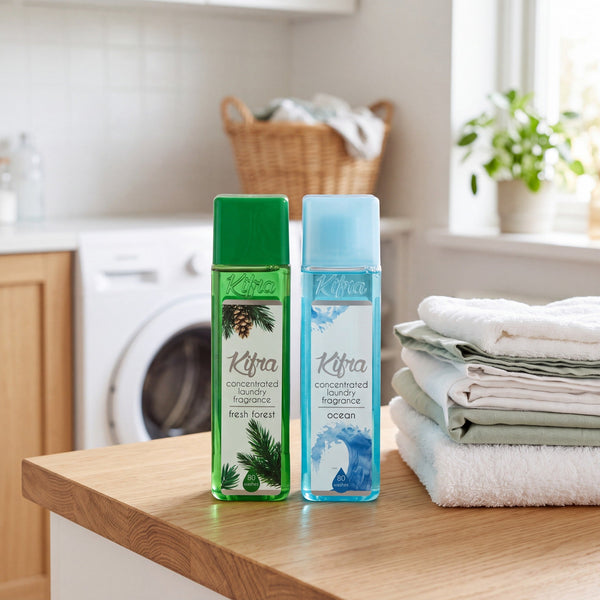
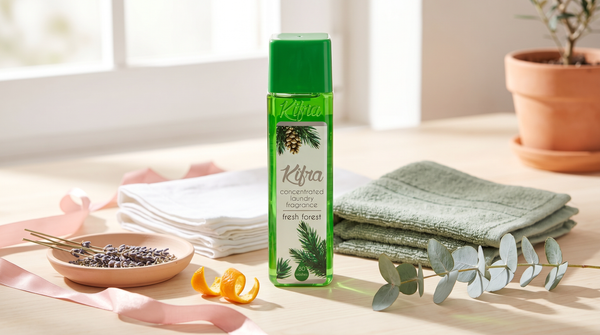
Once the first wash finishes and the fibres are clean and softener-free, run a second short wash with a concentrated laundry perfume in the softener drawer. A 2.5 ml dose of Kifra in the softener compartment is enough — that's the recommended manufacturer dose, and at 80 washes per 200 ml bottle, the cost per second-wash is around 14p. Reach for the Kifra range if you want a forest-and-citrus profile; reach for an Asevi Sensations softener if you want something pink-and-floral.
This second wash is what turns a cleaned charity-shop garment into one that smells new.
Step 5 — Air-dry, then store with scent
Tumble drying will undo a fair bit of step 4. The combined heat and tumbling break the fragrance-to-fibre bond and pull most of the scent off the clothes before they're back in the wardrobe. Air-dry on a rail, an airer or a line in a bright window. Once dry, hang the clothes back in the wardrobe alongside a small cotton-wool ball dabbed with a few drops of the same Kifra you used in the wash. The scent will continue settling into the fibres over the first few days of storage.
By day seven, the charity-shop garment will smell indistinguishable from anything else on the rail.
Fabric-specific tips
Cotton and linen. Tolerate the full routine — 40 °C wash, 60 °C if they're towels or bedding, full strip-wash bath. The most rewarding fabrics to rescue. A vintage cotton shirt will come out feeling crisp again.
Wool and cashmere. Skip the bicarbonate-of-soda bath. Hand-wash gently in lukewarm water with a delicate wool detergent (Norit Negro is the Spanish standard, or any UK wool-specific detergent), rinse cold, lay flat to dry. For scent, lay a Kifra-dabbed cotton wool inside the folded jumper while it dries.
Synthetics. Stick to a 30 °C wash with concentrated detergent and skip the strip-wash bath — bicarbonate of soda can mark some synthetic dyes. The second-wash-with-scent step still works.
Silk. Hand-wash only, with a silk-specific detergent. Air-dry away from direct sunlight. For scent, use a fabric mist after drying rather than a wash-cycle perfume.
Denim and dark colours. Wash inside-out at 30 °C with a dark-specific detergent (Norit Negro again, or any UK dark-fabric line). Use only half the usual concentrated-perfume dose in the second wash, because dark fabrics hold scent longer and over-dosing reads as heavy on a black t-shirt.
Five mistakes that make charity-shop smells worse
Washing without airing first. Trapping musty fibres in the drum for an hour with hot water turns the mustiness into a steamed-in version of itself. Air first, every time.
Using fabric softener in the first wash. Softener coats the fibres in a layer of fragrance and polymer that locks in whatever smell was there before. Empty softener compartment, always, for the first machine wash.
Drying on a tumble dryer at high heat. Heat fixes any remaining body-oil or perfume notes into the fabric. Low heat at most, or air-dry properly.
Skipping the second wash. A clean charity-shop garment that hasn't been given any scent of its own will still smell faintly of the wash — and faintly of the shop. The second-wash-with-scent step is what makes it smell yours.
Storing in a damp wardrobe. All of the above is undone if the wardrobe smells faintly off. Keep a dish of bicarbonate of soda at the back of the wardrobe for a fortnight after putting away your rescued clothes — it absorbs whatever musty notes try to creep back in.
Frequently asked questions
Why do charity-shop clothes smell musty?
Most pre-loved clothes pick up a faint storage smell during their time in the shop's back room, plus a layer of the previous owner's detergent, fabric softener and skin oils that an ordinary 40 °C wash doesn't fully remove. Airing the garments before washing, then using a strip-wash soak with bicarbonate of soda, clears most of it.
Can you use bicarbonate of soda to wash clothes?
Yes — a half to one full scoop in a bath of hot water alongside a small amount of washing soda and powdered detergent makes a gentle "strip-wash" soak that lifts out built-up fabric-softener residue, body oils and storage mustiness. Soak for two to four hours, then rinse and put through a normal machine wash.
What's the best laundry perfume for second-hand clothes?
A concentrated laundry perfume gives the best result because it adds noticeable scent on a clean, softener-free fibre — exactly the state the second wash leaves the clothes in. Kifra is the Dulce Armonía favourite for first-time rescuers: a 200 ml bottle is rated for 80 washes at the recommended 2.5 ml dose, with the Fresh Forest profile reading fresh rather than perfumey.
Ready to rescue?
The whole routine takes a Saturday afternoon and costs less than the price of a new t-shirt. If you're starting from scratch and want to know what to buy first, the two bottles that handle the most charity-shop rescue work in our experience are Kifra Fresh Forest 200ml (for the scent step) and Asevi Pink Talco/Rosa (for an everyday softener you'll keep using for years after).
Shop Kifra Fresh Forest 200ml → Shop the Asevi range →
Want the full long-lasting laundry routine that pairs with this guide? Read how to make your laundry smell amazing for weeks. Backed by 1,000+ verified eBay reviews and 2,000+ TikTok reviews under @dulcearmonia.