If your towels smell wonderful coming out of the wash and like nothing at all by the time you reach for them the next morning, you are not alone. Towels are the hardest fabric in the wardrobe to scent reliably — and the reasons why are quietly fixable, once you know what to look for.
Here is the full diagnosis of why towels stop holding scent, the five most common causes, and the simple wash-and-store routine that brings them back to bedding-shop freshness for the long term.
Why towels are the hardest scent challenge in the house
The short version: towels are the densest, thirstiest, most wash-cycled item in most British homes. Each of those facts works against fragrance.
Towels are denser than most fabric. A typical cotton bath towel has roughly four times the weight of fibre per square metre as a cotton bed sheet. More fibre means more surface area for residue to build up, and more places for fresh fragrance to lose the competition with whatever was there before.
Towels are repeatedly soaked. A towel's main job is to absorb water from your body, then to release that water as it air-dries on a rail. That repeated soak-and-release cycle pulls fragrance out of the fibres faster than the same cycle in a t-shirt or a duvet cover would.
Towels are washed more often than almost anything else. And every wash with a residue-leaving detergent or fabric softener adds another microscopic layer of coating that future fragrance has to push through.
This isn't a defect. It's the job towels are doing. But it means that the routine that works for shirts or bedding will fall short on towels — and a small adjustment makes all the difference.
Five reasons your towels stop smelling
Most cases come down to one of five quietly common causes. Run through them in order; the first one that applies is usually the answer.
1. Detergent and softener residue has built up in the fibres
The most common cause by some distance. After a year or two of supermarket detergent and fabric softener, towels carry a fine internal coating of polymer and waxy softener residue. The coating reduces absorbency, traps a faintly musty under-note, and physically blocks new fragrance from reaching the cotton fibres underneath.
You can sometimes feel this before you smell it — older towels often feel slightly stiff or waxy when dry, and don't dry your skin as quickly as a new towel does. That's the residue at work.
The fix: a one-off laundry strip. Soak the towels for two to four hours in hot water with a generous scoop of bicarbonate of soda, a smaller scoop of washing soda, and a half-scoop of powdered detergent. The water will visibly cloud as the build-up lifts out. Rinse, then run a normal hot wash. We cover the full method in how to make your laundry smell amazing for weeks; the short version is enough to revive most British bath towels in a single Saturday afternoon.
2. You're using the wrong product, in the wrong slot
Most UK supermarket scent boosters are designed to give a strong "out-of-the-tumble-dryer" hit and accept that the scent will fade within a few days. That release profile is fine on a shirt you only wear once before its next wash, but it's not built for towels that sit folded for a week between uses.
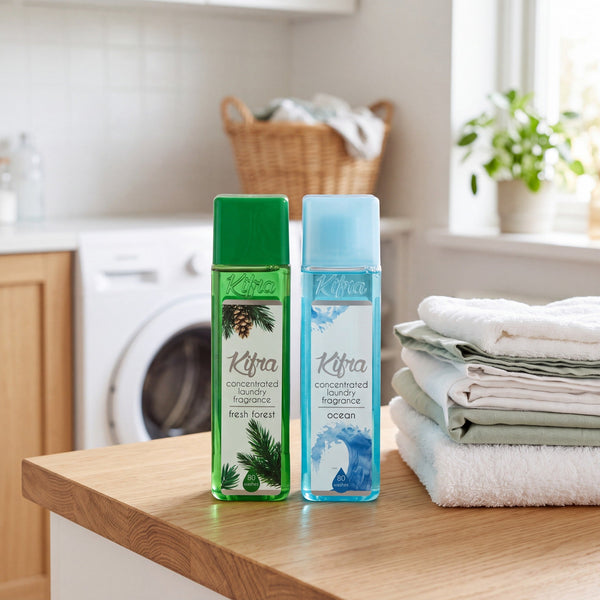
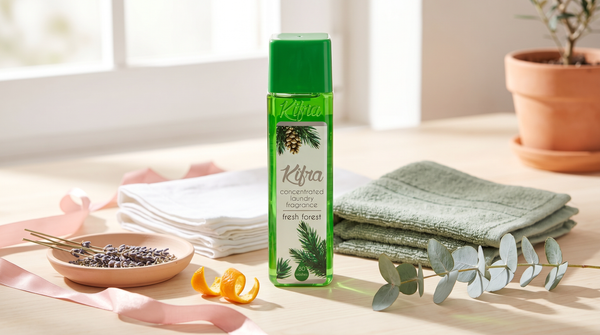
A concentrated laundry perfume — like the bottles in the Kifra range — is built differently. The fragrance oil is suspended in a small carrier and designed to release gradually as fabric dries and rests. On a folded towel, that means scent that's still detectable on the rail rather than only at the door of the machine.
The fix: swap from a pearl booster to a concentrated laundry perfume. A 200 ml bottle of Kifra Fresh Forest is rated for 80 washes at the recommended 2.5 ml dose — about 14p per wash at our current price. Pour the dose into the fabric softener compartment, not directly into the drum.
3. You're dosing into the drum, not the softener compartment
This is the small-but-critical mistake that even experienced launderers make with concentrated perfumes. If you pour a 2.5 ml dose into the drum at the start of the cycle, most of the fragrance oil dilutes across the whole wash, binds to the rinse water rather than the towel, and goes down the drain when the machine empties.
The softener compartment is the right slot for almost any scent product. It releases at the end of the cycle — the moment when the rinse water is at its calmest and the fibres are most receptive. Same product, same dose, dramatically different result.
The fix: every wash from now on, the laundry perfume goes in the softener compartment. Never the drum.
4. The tumble dryer is undoing the work
Tumble drying is a scent killer for towels. The combined heat, tumbling, and forced airflow break the fragrance-to-fibre bond and pull most of the scent off the towel before it gets to the airing cupboard. A fifty-minute hot cycle can take an enormous portion of the scent off a freshly washed bath towel.
This is one of the reasons towels in Mediterranean homes hold their scent longer — most are air-dried on a balcony rail or a heated airer, not run through a tumble dryer.
The fix: air-dry where you can, on a radiator, a heated airer or a clothes line in a bright window. If you must tumble dry, set it to low, pull the load early while the towels are still very slightly damp, and finish on the rail.
5. The airing cupboard or shelf is letting you down
Even a perfectly washed, perfectly air-dried towel can lose most of its scent in storage, if the cupboard it lives in is damp, cluttered or stale. A damp cupboard re-activates whatever residue is still in the fibres and brings back a faintly musty under-note that competes with the fresh top of the scent.
The fix: check the airing cupboard. Cupboards above a hot-water tank are ideal — warm and bone-dry. Under-stair cupboards are usually too cold and slightly damp. If yours is the second kind, leave the door cracked open for an hour a day, and tuck a dish of bicarbonate of soda at the back to absorb whatever damp tries to creep in. A small cotton-wool ball dabbed with a few drops of the same Kifra you used in the wash, placed on the shelf, will quietly re-scent the cupboard wash after wash.
The four-week towel reset
If your towels have lost their smell for any of the reasons above, here is the sequenced fix. It takes a Saturday afternoon and a small adjustment to the wash routine for the four weeks that follow.
Week 1 — Saturday afternoon. Strip-wash all the towels in one go (full method in the laundry-smell guide). Air-dry. Don't put them away yet.
Week 1 — Sunday. Run a normal hot wash on the stripped towels with concentrated detergent only, no softener or perfume. Dry on a rail.
Week 2 onwards. Use a concentrated laundry perfume in the softener compartment for every towel wash. We recommend a 2.5 ml dose of Kifra Fresh Forest. Air-dry, then store with a Kifra-dabbed cotton wool at the back of the cupboard.
By week four, the towels will smell distinctly different from where they started — and they will keep doing so, washload after washload, as long as the residue doesn't build up again.
When it isn't your fault
Three situations make towel scent harder no matter what you do. Worth ruling them out before you blame your routine.
Hard water. Parts of the UK have very hard tap water, which leaves a mineral coating on fibres over time. If you live in London, the South East or East Anglia, your towels need stripping more often (every six months rather than every twelve) and may benefit from a small dose of washing soda in every wash to soften the water.
An older washing machine drum. Drums that haven't been cleaned in a long time develop a biofilm in the seal and the detergent drawer that quietly pushes a faintly stale note into every wash. Run a 90 °C empty wash with a washing-machine cleaner once a quarter to keep this in check.
Too-thick towels. Very heavy, hotel-style towels (above ~700 gsm) are wonderful for absorbency but harder to scent and harder to dry. If you have these, double the routine and air-dry for a full 24 hours before putting them away.
Frequently asked questions
Why don't my towels hold scent like new ones do?
Towels accumulate detergent and fabric softener residue over time, which coats the fibres in a thin layer that blocks new fragrance from bonding properly. A one-off laundry strip with bicarbonate of soda and washing soda lifts the residue out, and switching to a concentrated laundry perfume — dosed into the softener compartment rather than the drum — keeps fresh scent in the fibres for noticeably longer.
How can I make my towels smell like a hotel?
Hotel towels are washed at high temperatures, air-dried on industrial rails, and scented in the softener compartment with a concentrated laundry perfume rather than a pearl booster. The same routine works at home: strip the towels first, then wash at 60 °C with a 2.5 ml dose of a concentrated laundry perfume in the softener drawer, and air-dry on a heated airer or radiator rather than tumble-drying.
How much Kifra should I use per towel wash?
Each Kifra bottle is rated for 80 washes at 2.5 ml per wash. Pour the dose into the softener compartment at the start of the cycle, never into the drum. A 200 ml bottle of Kifra Fresh Forest costs £10.99 at Dulce Armonía — roughly 14p per wash — and will scent every towel wash for around two months in a single-person household.
Ready to bring them back
Start with one bottle of Kifra Fresh Forest and a kilo bag of bicarbonate of soda. Block out a Saturday afternoon for the strip-wash, and follow the four-week reset above. The first time you reach for a towel days later and it still smells like the wash, you will not go back.
Shop Kifra Fresh Forest 200ml → See the full Kifra range →
Backed by 1,000+ verified eBay reviews and 2,000+ TikTok reviews under @dulcearmonia. British shipping, no minimum, English-language support.