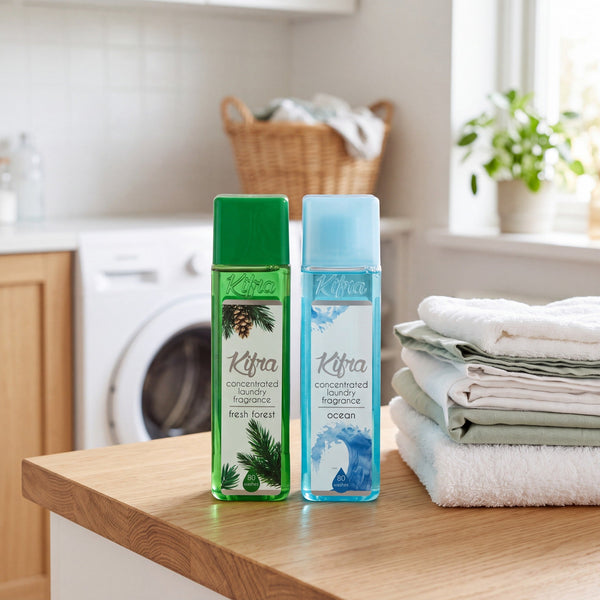
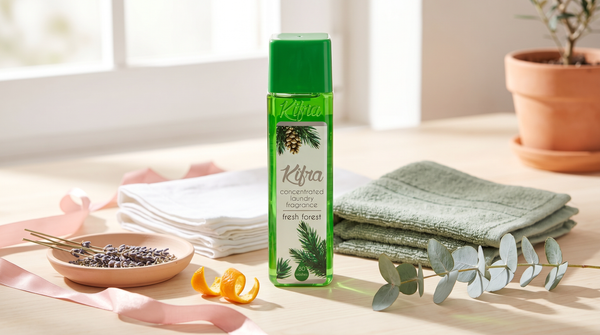
A bottle of Kifra is small for a reason.
Two hundred millilitres of concentrated fragrance oil, designed to last eighty washes and to release scent gradually over days rather than minutes, asks for a slightly different relationship than the five-litre tubs most British shoppers are used to. It rewards care. Stored right, dosed right and used in the right slot, a single bottle quietly scents around two months of laundry in a single-person household. Stored badly, dosed carelessly or poured in the wrong place, the same bottle disappoints in a fortnight.
Here is everything you need to know to get every last drop out of your Kifra: the correct dose, the right place to put it, how to store the bottle, what to avoid, how to troubleshoot a fade, and what to do with the empty bottle when you finish.
The basics — what's in your hand
Kifra is a Swiss-formulated concentrated laundry perfume, manufactured in Romania. A 200 ml bottle is suspended fragrance oil in a small carrier base, with a recommended dose of 2.5 ml per wash and a manufacturer-rated yield of 80 washes per bottle. At our current retail price of £10.99 for the 200 ml bottle, that works out at roughly 14p per wash.
Two important things flow from that maths.
One: Kifra is more concentrated than a UK supermarket pearl booster. A small dose goes a long way. Over-pouring doesn't make the scent stronger or longer-lasting — it just spends the bottle faster and can leave a heavier, slightly stuffy note on the fabric.
Two: Kifra is precious. Each bottle is a small object and the contents reward being looked after. Most of the rest of this guide is about how to look after them.
How to dose Kifra correctly
The recommended dose is 2.5 ml per wash, poured into the fabric softener compartment of your machine, never into the drum.
Why 2.5 ml is the right amount
Two and a half millilitres is a slightly awkward amount to measure by eye. It's roughly half a teaspoon, or one full cap of the small dosing cup that ships with the bottle. If your bottle didn't include a cap, a cheap pharmacy syringe or measuring spoon will do the job for the cost of a coffee. We recommend keeping the measuring cap or spoon in the utility cupboard next to the bottle so the dose stays consistent wash to wash.
Under-dosing (below ~1.5 ml) gives a noticeably weaker result that's barely detectable on the fabric a few days later. Over-dosing (above ~4 ml) doesn't make the scent meaningfully stronger or longer-lasting — the limiting factor is how much fragrance the fabric can actually carry, not how much oil you can pour into the drawer. The extra simply rinses away.
Why the softener compartment, never the drum
This is the single most-asked-about part of using Kifra correctly, so it's worth taking a moment over.
Most modern washing machines have three slots in the detergent drawer: one for pre-wash, one for the main wash detergent, and one for fabric softener or conditioner. The softener slot is the right home for Kifra. It releases at the end of the cycle — the moment when the rinse water is at its calmest, the detergent has been flushed out, and the fibres are most receptive to a fresh layer of fragrance.
Pouring Kifra straight into the drum, by contrast, dilutes the dose across the whole cycle. Most of the fragrance oil binds to the rinse water rather than the fabric and goes down the drain when the machine empties. Same product, same dose, dramatically weaker result. Even experienced launderers fall into this trap when they switch from a pearl booster (which is designed to be drum-loaded) to a concentrated perfume (which is not).
For more on this and the rest of the dosing routine, see how to make your laundry smell amazing for weeks.
How to store the bottle
Concentrated fragrance oils are quietly delicate. Heat, direct sunlight and prolonged contact with air all very slowly degrade the top notes of any fragrance — the brightest, freshest part of the profile. Three small storage habits keep a bottle smelling as fresh in month six as it did on the day it arrived.
Keep it out of direct sunlight. A south-facing windowsill, the top of a tumble dryer, or a shelf next to the boiler will warm a bottle of Kifra to a temperature high enough to slowly oxidise the fragrance oils. A cool dark cupboard — the same kind of place you'd store olive oil — is ideal. Inside a utility cupboard with the door closed is perfect.
Keep it upright with the cap firmly closed. A loose or partially-open cap lets a tiny amount of fragrance oil evaporate every day. Over a year, that adds up to a noticeably weaker bottle even if the contents are otherwise full. The cap should be on tight whenever the bottle isn't actively being poured.
Keep it away from the radiator. Storing the bottle near a heat source — the back of a hot airing cupboard, on top of a radiator, near the boiler — accelerates the same gentle degradation that sunlight causes. Aim for a steady room-temperature spot.
Shelf life: how long does a Kifra bottle last?
An unopened bottle of Kifra, stored properly as above, will hold its fragrance profile well for at least 24 months from the date of manufacture (check the small batch and date code on the underside or back of the bottle). Most bottles store far longer than that without noticeable degradation, but 24 months is the comfortable window.
Once opened and in use, a bottle will typically smell its best for around 12 months. After that, the top notes begin to soften gently — not unusable, but slightly different from how it smelled when fresh. At the 80-washes-per-bottle pace, most households will finish a bottle well inside that 12-month window, so this is mostly a non-issue.
Using Kifra across different fabric types
The 2.5 ml softener-compartment dose works for almost every load. There are a handful of small adjustments worth knowing for specific fabric types.
Cottons and bedding — the everyday case. 2.5 ml in the softener compartment, wash at 30 to 40 °C, air-dry or low-tumble. Add the same dose for a 60 °C towel or bedding wash; the formula tolerates hot washes well.
Towels — the hardest fabric in the house to scent reliably. The dose stays at 2.5 ml, but the work begins with a one-off strip-wash to clear residue and continues with consistent air-drying. The full towel routine lives in my towels don't hold scent — help.
Wool, cashmere and delicates — drop the dose by half. A 1.25 ml dose in a delicate wash is plenty; wool fibres hold scent for noticeably longer than cotton, and a full dose can read as heavy after a few days.
Synthetics — full dose works, but synthetics generally hold scent for less time than natural fibres. Add a Kifra-dabbed cotton-wool ball to the drawer where the garment is stored to extend the scent past the wash.
Dark fabrics — drop the dose by half here as well. Dark fibres hold scent disproportionately and over-dosing can read as heavy on a black t-shirt that's worn close to the face.
Cold wash — the same 2.5 ml dose works at 20 to 30 °C, and Kifra's release profile is actually slightly more efficient at lower temperatures, because more of the fragrance oil bonds to fibre rather than dispersing into hot water.
Five things to avoid with Kifra
A short do-not list, ordered by how often the mistake comes up.
Don't combine Kifra with fabric softener in the same wash. Pearl boosters and Kifra both compete for the softener slot, but Kifra and a softener combined in one wash do something worse — the softener coats the fibres in a polymer layer that the Kifra fragrance oil cannot get through, and you end up with the softener's note dominating. If you want the comfort of a softener and the longevity of Kifra, use them in alternating washes, not the same one.
Don't pour Kifra directly onto dry fabric. The product is too concentrated. Spotting undiluted Kifra onto a shirt will leave a visible oily mark and a heavy, top-note-dominated patch of fragrance that doesn't fade evenly. If you want a fabric mist for in-between washes, dilute one cap of Kifra into 100 ml of water in a spray bottle and use that instead.
Don't use Kifra as a body perfume or skin fragrance. It isn't formulated for skin and contains a higher fragrance-oil load than a finished personal perfume would. Use it for laundry and home fragrance only.
Don't put it in the detergent compartment. The detergent slot releases at the start of the wash, when warm water is flooding the drum and the fragrance has the worst possible window for bonding to fibre. The softener slot at the end of the cycle is the only correct home.
Don't mix Kifra with bleach in the same wash. Bleach denatures fragrance oils on contact and you'll lose most of the Kifra's scent within minutes. Run a bleach wash on its own and a Kifra wash on the next cycle if both are needed.
Troubleshooting — when Kifra isn't holding scent
If a wash with Kifra hasn't given you the result you expected, run through the four most common causes in order. The first one that applies is almost always the answer.
Are you dosing into the softener compartment, not the drum? If you're drum-loading, switch slots immediately. Same product, same dose, dramatically different result on the next wash.
Are your towels or bedding carrying residue from previous detergents? A long history of supermarket fabric softeners leaves a thin coating in the fibres that blocks new fragrance. A one-off strip-wash with bicarbonate of soda and washing soda fixes this in a single afternoon. Full method in the laundry-smell guide.
Are you tumble drying on a high setting? Tumble drying breaks the fragrance-to-fibre bond and pulls most of the scent off in a single cycle. Switch to air-drying or a low-heat tumble with an early stop.
Is the bottle itself in good condition? Run a quick smell test on the bottle. If it smells noticeably weaker, flatter or different from the day you opened it, the bottle has been stored badly — most likely in too much light or heat, or with the cap loose. The remaining contents will still work, but the fragrance profile is no longer at its best. Decant into a smaller bottle, store in a cool dark cupboard, and start a fresh bottle for important loads.
Recycling and disposal
Each Kifra bottle is HDPE (recyclable plastic, recycling code 2) with a polypropylene cap (recycling code 5). Both are widely recyclable through UK kerbside collection. Rinse the bottle with warm water before recycling — a small amount of fragrance residue is fine, but a half-full bottle will not be accepted at most facilities.
If you want to extend the bottle's life beyond its contents, the empty bottle works well as a refill container for the diluted fabric mist described earlier (one cap of fresh Kifra to 100 ml of water in a spray bottle).
Frequently asked questions
How much Kifra should I use per wash?
The recommended dose is 2.5 ml per wash, poured into the fabric softener compartment of your washing machine, never into the drum. At this dose a 200 ml bottle is rated for 80 washes — about two months of laundry in a single-person household. Over-dosing above 4 ml gives no meaningful benefit and simply uses the bottle faster.
How should I store my Kifra bottle?
Store the bottle upright, with the cap on tight, in a cool dark cupboard away from direct sunlight and heat sources. A utility cupboard with the door closed is ideal. Avoid radiators, south-facing windowsills, the top of a tumble dryer, or anywhere the bottle warms up regularly. Stored properly, an unopened bottle holds its fragrance well for at least 24 months.
Can I use Kifra in a tumble dryer?
Not directly — Kifra is a concentrated liquid designed for the softener compartment of a washing machine, not for the dryer. If you want a tumble-dryer scent, add a Kifra-dabbed cotton-wool ball to the drum on a low-heat dry cycle, or (better) air-dry instead. Tumble drying on a high setting will pull most of the Kifra scent off the fabric whether or not anything is added to the dryer.
Can I take Kifra on a plane?
Only as checked luggage at the full 200 ml size, or as a 100 ml decant in hand luggage under UK and EU airline liquid rules. The full long-trip routine — decant bottle, in-case scent reservoir, hotel refresh — lives in the travel laundry guide.
A bottle worth looking after
A bottle of Kifra, used carefully, scents two months of laundry, refreshes a wardrobe between washes, and arrives at the end of its life having quietly built a different feel into the whole home. None of that requires special skill — just the small, settled habits in this guide, repeated wash after wash. Treat the bottle as something worth looking after, and it will repay the attention.
Shop Kifra Fresh Forest 200ml → See the full Kifra range →
Want the full long-lasting laundry routine that pairs with this care guide? Read how to make your laundry smell amazing for weeks. Backed by 1,000+ verified eBay reviews and 2,000+ TikTok reviews under @dulcearmonia.